
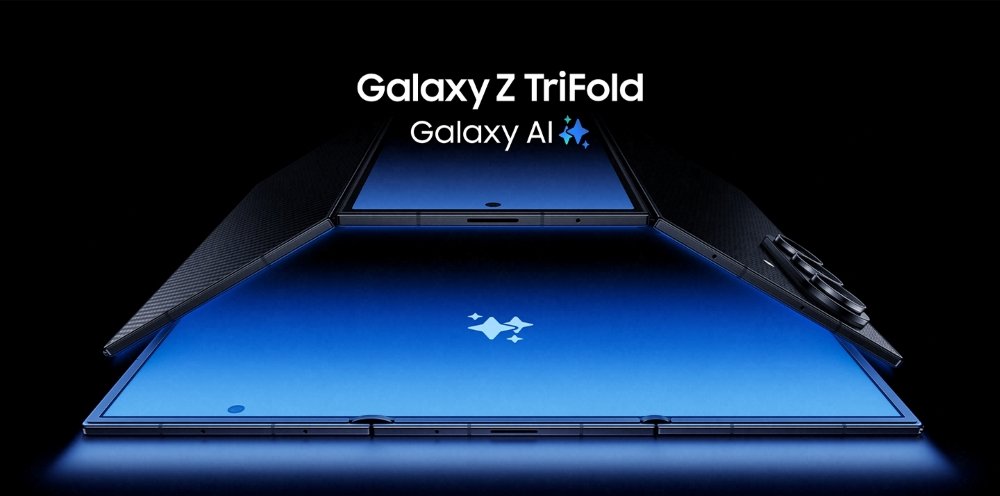
Overview Table
| Category | Details |
|---|---|
| Product Identity | Samsung Galaxy Z Trifold |
| Core Concept | Triple-segment foldable device enabling phone, tablet, and workstation modes |
| Design Structure | Three-panel chassis, precision hinges, ultra-thin flexible glass, reinforced spine frame |
| Display Architecture | Multi-section AMOLED panels, adaptive refresh, seamless continuity across folds |
| Performance Engine | Flagship processor, tri-layer thermal distribution, enhanced multi-window parallelism |
| Software Layer | Flex OS, adaptive layout shifting, multi-panel workflows, continuity memory |
| Camera System | Multi-position array, flex-based angles, AI-stabilized optics |
| Battery & Charging | Multi-cell symmetrical layout, intelligent bridging for folded/unfolded modes |
| Target Audience | Creators, productivity-driven users, travelers, professionals, tech enthusiasts |
| Device Philosophy | Expandable computing in pocket form using folding geometry |
| Market Position | Experimental ultra-premium flagship leading the next phase of foldable evolution |
Introduction: The Birth of a New Form Factor
The Samsung Galaxy Z Trifold represents one of the most ambitious attempts in smartphone evolution. For years, foldables revolved around a two-panel concept, where devices either folded inward like a book or outward like a flexible slab. But the idea of a three-segment foldable has floated within tech circles as the future of portable computing, a concept that redefines what a mobile device can transform into. The Samsung Galaxy Z Trifold takes this idea from speculation to reality, creating a transformative device that acts as a phone, a tablet, and a multi-panel workstation, all within a single, pocket-sized form.
This device is not simply a larger foldable. It is a reimagination of how digital tools fit into daily life. It blurs the boundaries between smartphone convenience and laptop-like productivity, creating a computing experience governed by geometry rather than rigid frames. Samsung’s engineering philosophy with the Samsung Galaxy Z Trifold centers on adaptability. In its smallest form, it is a compact, manageable smartphone. In its middle configuration, it becomes a wide display suitable for media consumption or multitasking. And at its full expansion, it becomes a tablet-class screen large enough for complex work.
The Samsung Galaxy Z Trifold highlights a new future: one where personal devices contain multiple identities and shift roles depending on how users physically shape them. This article explores every dimension of the Samsung Galaxy Z Trifold—design, mechanics, display engineering, software intelligence, battery architecture, camera versatility, and long-term market potential. The purpose is not to list specifications but to understand how this device redefines mobile technology and user interaction.
1. Design Philosophy: Engineering a Device With Three Identities
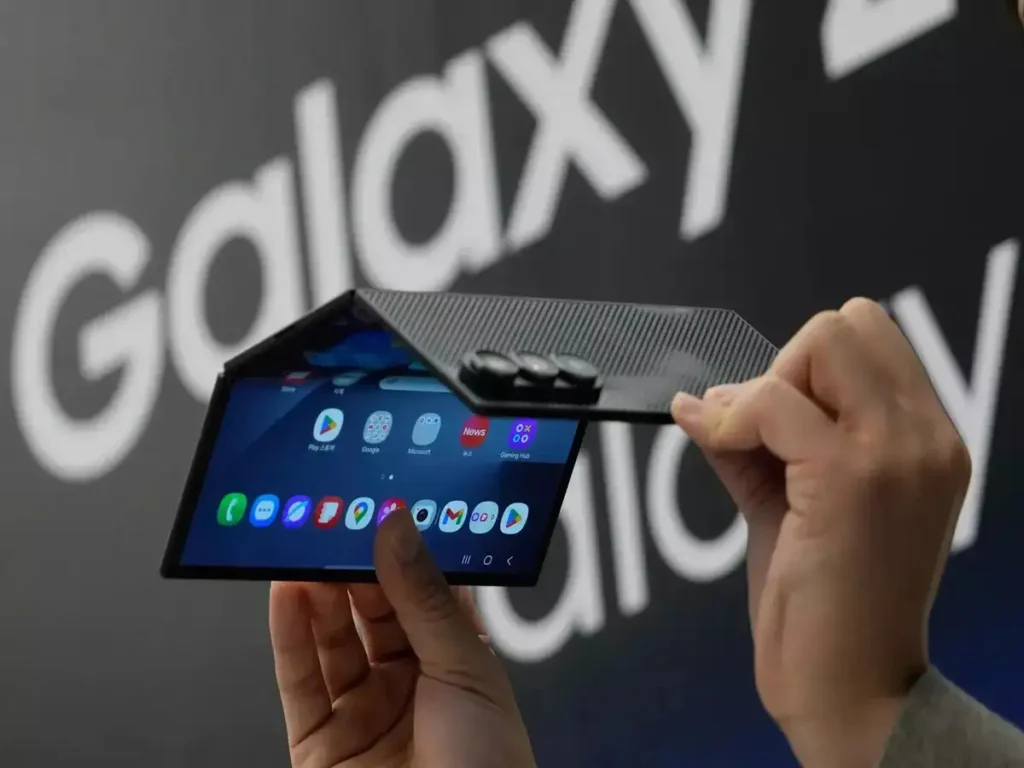
Designing a trifold device requires an entirely different approach from traditional foldables. Two hinges, three display segments, reinforced frames, and complex weight distribution must work seamlessly. Samsung builds the Samsung Galaxy Z Trifold around a principle of structural clarity: every panel must serve a functional and structural purpose.
1.1 The Three-Panel Geometry
A trifold device must maintain consistency across three segments. Each panel is crafted from ultra-thin flexible glass layered with a protective polymer coating. The segments are symmetrical in height but vary slightly in thickness to accommodate internal components without creating uneven pressure points.
The center segment is engineered as the anchor section, holding the primary motherboard, cameras, and battery distribution control. This centralization allows the outer segments to remain slimmer, improving foldability and reducing stress on the hinges.
1.2 Reinforced Spine and Precision Hinges
The Samsung Galaxy Z Trifold uses a dual-hinge mechanism built to fold inward like an accordion. The challenge with dual hinges is ensuring synchronized movement. When folding a three-panel device, misalignment by even half a millimeter would compromise the long-term durability of the flexible glass. Samsung’s hinge mechanism therefore utilizes synchronized gear units that ensure both sides fold at identical speed and alignment.
Each hinge includes micro-cushioning layers to redistribute pressure when the device is closed. This prevents the center panel from receiving disproportionate stress. The reinforced spine provides torsional rigidity, reducing flex when the device is fully open, giving the screen a tablet-like solidity.
1.3 Materials, Texture, and Tactile Balance
Despite its complexity, the Samsung Galaxy Z Trifold must remain usable as a daily smartphone. Samsung employs matte metal finishes to enhance grip, reduce fingerprint retention, and present a refined aesthetic. The device’s back surface incorporates micro-textured patterns that improve friction without affecting minimalistic visual appeal.
Balancing the weight of a trifold device is critical. If too heavy, daily use becomes tiresome. If too light, structural integrity suffers. Samsung solves this by distributing the battery cells across segments, reducing bulk on a single side and enhancing ergonomic balance whether used as a phone or tablet.
The design communicates confidence. It stands not as a futuristic prototype but as a device meant for everyday life.
2. Display Architecture: The Challenge of Continuity Across Three Panels
The display of the Samsung Galaxy Z Trifold is its most defining component. It must function seamlessly whether folded twice, once, or fully expanded. It must maintain visual consistency even as its physical shape changes.
2.1 Triple-Segment AMOLED Engineering
Each panel integrates an AMOLED layer calibrated to match brightness, color tone, and refresh rate with the others. Achieving display uniformity across three flexible segments is difficult because flexible AMOLED panels can show subtle luminance and hue deviations when bent repeatedly. Samsung solves this through advanced pixel compensation circuits embedded into the display controller.
This ensures that as the device ages, the screen remains visually unified.
2.2 Adaptive Refresh and Real-Time Panel Coordination
The display uses adaptive refresh rates that adjust based on folded state. In phone mode, only one panel is active, allowing lower refresh rates for power savings. When partially unfolded, two panels activate with coordinated refresh mapping. In full mode, the entire spread operates under a unified refresh algorithm to prevent visual tearing or lag.
The system constantly evaluates which parts of the display are folded, adjusting temperature distribution, power flow, and pixel brightness accordingly.
2.3 Seamless Visual Continuity
One of the most impressive aspects of the Samsung Galaxy Z Trifold display is the transition between modes. When the device unfolds from single-panel to double-panel view, the UI expands fluidly, maintaining content continuity. This effect extends to apps, media, and multitasking layouts.
Samsung designs a custom display controller that merges three separate pixel grids into one logical display. This architecture ensures users never feel the seams between segments, physically or visually.
3. Flex Mode Evolution: Adaptive Geometry as Interface Philosophy
The Samsung Galaxy Z Trifold is designed around the idea that physical actions create software responses. Each folding angle triggers interface changes, allowing the device to adapt its capabilities to its geometry.
3.1 Phone Mode: Compact and Intentional
When fully folded, only one front display segment is active. This mode mirrors traditional smartphone interactions. Samsung ensures that despite the device’s complex nature, phone mode remains efficient for:
- Calling
- Messaging
- App navigation
- Quick tasks
- Camera use
The UI remains uncluttered, preserving simplicity even within a highly advanced device.
3.2 Wide Mode: The Two-Panel Experience
Unfolding the device halfway activates two connected panels. This mode is ideal for:
- Watching videos
- Browsing in landscape
- Gaming
- Reading
- Split-screen multitasking
The device behaves like a small tablet, offering a wider canvas without the full footprint of the three-panel expansion.
3.3 Full Mode: Tablet-Class Productivity
Fully expanded, the Samsung Galaxy Z Trifold becomes a large display, ideal for:
- Desktop-style workflows
- Multitasking with multiple floating windows
- Design and drawing
- Spreadsheets and documents
- Research and reading side-by-side
The device resembles a compact workstation for professionals on the move.
3.4 Multi-Angle Flex Positions
Each hinge supports stable angles, enabling:
- Laptop-like typing mode
- Tent mode for media consumption
- Stand mode for video calls
- Dual orientation modes for creative tasks
Samsung’s implementation treats the device like a flexible computing tool rather than a rigid phone.
4. Performance Engine: Processing Built for Parallel Workflows
A device capable of transforming between geometric states needs a processor resilient enough to handle shifting workloads.
4.1 The Flagship Core Architecture
The Samsung Galaxy Z Trifold features a flagship chipset engineered for multitasking and real-time display adjustments. Large core clusters handle heavy workloads like editing, gaming, or rendering. Smaller efficiency cores manage lightweight tasks to preserve power.
4.2 GPU Optimization for Triple-Panel Rendering
Rendering across three display sections is computationally intense. The GPU employs dynamic load balancing to determine which display areas require active processing, reducing unnecessary strain.
4.3 AI-Assisted Resource Distribution
The AI engine monitors:
- Fold state
- App demands
- Thermal conditions
- User behavior patterns
It allocates resources intelligently, ensuring smoothness without overheating or excessive power consumption.
4.4 Thermal Management Across a Multi-Segment Structure
Samsung distributes heat pipes and graphene layers across all panels. This prevents localized hotspots and maintains performance consistency regardless of how the device is folded.
Performance remains stable even during extended high-load sessions, an essential requirement for a device marketed as a workstation-class mobile tool.
5. Software Architecture: Flex OS and Multi-Panel Intelligence
Software defines the user experience more than hardware in a device with shifting identities. The Samsung Galaxy Z Trifold uses an adaptive interface layer designed specifically for folding geometry.
5.1 Continuity Memory
Apps remember their position and orientation when the device changes state. For example, a document opened in phone mode expands into a two-panel workspace with additional toolbars when partially unfolded.
5.2 Multi-App Parallelism
Users can open up to three or more windowed apps on the large layout, dragging and resizing them freely like a desktop environment. This allows:
- Research on one panel
- Writing on another panel
- Communication on a third
5.3 Control Bars and Task Shortcuts
The edges of the screen host adaptive control bars that appear and disappear depending on:
- Orientation
- Fold state
- Running apps
These bars serve as quick-access hubs for tools, recent apps, and layout adjustments.
5.4 Enhanced Productivity Ecosystem
The Samsung Galaxy Z Trifold integrates seamlessly with:
- Tablets
- Laptops
- Samsung DeX
- Cloud services
- Wireless casting
This allows the device to act as a standalone productivity center or as part of a larger workflow.

6. Camera System: Multi-Position Photography for a Multi-Form Device
The camera system is designed to leverage the device’s flexible form. Multi-angle capture, stabilized frames, and adaptive sensors turn the trifold into a creative tool.
6.1 Lens Arrangement
The camera array is positioned on the central panel to ensure balanced capture regardless of fold state.
6.2 Flex-Based Shooting Angles
Users can position the device at various angles for:
- Hands-free video calls
- Timelapse setups
- Low-angle photography
- Stabilized long-exposure shots
6.3 AI Imaging Intelligence
The AI system recognizes orientation, lighting, and camera angle, optimizing settings instantly. This ensures consistent performance whether shooting in compact or fully expanded mode.
6.4 Video Capabilities
The Samsung Galaxy Z Trifold supports:
- Wide-angle recording in full mode
- Selfie recording in tent mode
- Productivity-focused camera use such as document scanning
It is designed to be versatile rather than purely specification-driven.
7. Battery, Power Management, and Longevity
A trifold device requires distributed power architecture.
7.1 Multi-Cell Design
Battery capacity is divided across segments, managed by a central controller to ensure synchronized discharge and charging.
7.2 Smart Power Scheduling
The device adjusts power draw based on:
- Fold state
- Active panels
- Task intensity
In phone mode, only essential components engage, preserving battery life.
7.3 Fast Charging With Thermo-Regulated Control
Heat monitoring ensures the device charges quickly without damaging components, crucial for a device with multiple battery cells.
8. User Identity: Who the Samsung Galaxy Z Trifold Is Made For
This device is intended for:
- Professionals who travel
- Students needing multi-window learning tools
- Creators who benefit from a larger mobile workspace
- Business users working with spreadsheets or documents
- Tech enthusiasts exploring future-forward designs
It appeals to users who value adaptability and want a device that can shift roles instantly.
9. Market Impact: A New Chapter for Foldables
The Samsung Galaxy Z Trifold sits at the frontier of mobile engineering. It introduces a new era where devices evolve beyond traditional form factors. While initial adoption will be niche, the long-term implications are significant:
- The line between phones and tablets will blur
- Ultra-mobile workstations may replace mid-range laptops
- App developers will adopt multi-panel design practices
- Foldable technology will reach its next stage of maturity
This device is a bold statement that mobile computing is shifting toward modularity.
Conclusion: A Device That Redefines Possibility
The Samsung Galaxy Z Trifold is not merely a technological experiment. It is a complete rethinking of what a mobile device can be. With its adaptive geometry, advanced display engineering, multi-layer performance architecture, and flexible software ecosystem, it stands as one of the most ambitious pieces of consumer technology ever created.
The Samsung Galaxy Z Trifold paves the way for a future where devices reshape themselves according to user needs. It challenges long-standing boundaries between phones, tablets, and workstations, creating a single product that embodies all three roles.
This is not evolution. It is a new beginning.
